Financial Letter - September 29th, 2019
241 Issue (since 01/24/2015)
CKL Inc. now offers a portfolio based essentially on performance (0.9/10): the 0.9 indicates the annual administrative % cost of management; the 10 represents the 10% of management fees on the gains above the high-water mark. The portfolio is made by only one US ETF, plus option strategies on the US market. This style of portfolio requires a capital of 250,000US$ or equivalent in CAD and the level 4 in options negotiation.
A short manual on Day Trading is now available on Kindle and other electronic reading platforms in French. The title is: « Le ‘Day Trading’ ou La négociation sur séance (1) », written by Charles K. Langford and Audrey Parent Thibeault.
A short manual on the put/call ratio is available on Kindle and on similar electronic reading platforms, in French. The title is: « L’antagonisme entre les options put et call: l’analyse du put/call ratio », written by Charles K. Langford and Laurence P. Darveau.
The book “L’alchimie qui crée l’or – Le chasseur de tendances boursières II” is available online on Kindle in French. The book is a “bestseller” in the category of business and finance. It's also available on all other readers platforms (Kobo, iBook, etc.).
The English version is available on all reading softwares like Kindle, Kobo, iBook, etc. Its title is “The Trend Hunter”.
The website of Charles K. Langford Inc. is: www.charlesklangford.com
Market Risk (Systematic Risk)
The market (S&P500 Index and its derivatives) ended the week lower at 2,961.79 points compared to the previous week at 2,992.07 points, down 1.0%. The worst sectors were the health care (-3.0%) and the energy (-2.6%). But, if tomorrow is a no event day, September finishes anyway with a gain of 1.2% of the S&P500 Index.
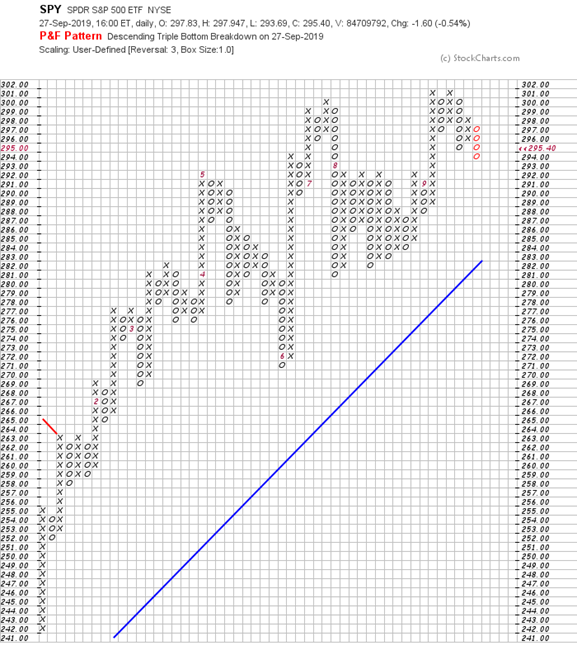
The chart of SPY shows a down signal at $294 with a short-term target at $289. This should be a normal drawdown in an overall bullish configuration. The Trump’s impeachment process is a no event or maybe a positive one for M. Trump, given the lack of consistency of the accusations against him.
The Langford Management
Presently our investments are in ETFs and ETN offering a high return, with a dividend yield between 5 to 10 % per year, at pro rata temporis, monthly. The market has a positive bias. We don’t think for the moment to change the allocation because also the products with higher returns are also bullish.
In the USD accounts, still we have cash in the form of FLOT, MINT, NEAR. In the CAD accounts, it is PSA or the equivalents. In the average, our portfolios are invested 60% in revenue and 40% in directivity.
In some, more aggressive accounts we have increased the capital synthetically with option strategies to profit of the upward momentum. In accounts that allow futures markets, we have futures contracts in long position on stock indexes.
Our portfolio management is always ad hoc, for each client. But also, we offer now five standardized mini-portfolios for clients interested:
- Bullish aggressive
- A contrarian as a hedge or profit
- Bullish and dividend oriented
- Against inflation
- Bullish, aggressive on non-traditional assets.
(The portfolio management fees of Charles K. Langford Inc. is 0.9% of assets, per year (equivalent to $900 per $100,000). The capital under management is invested exclusively in ETF, ETN and options)
Among a group of selected stocks and ETFs, this week we have middle- and long-term buy signals on the following stocks and ETFs.
TREND FOLLOWING
|
Middle-term bullish |
Long-term bullish |
|
|
Canadian Market |
AVU.V |
MWX.V |
About Options
Investors that believe the current Canadian market offers interesting bullish opportunities, can buy the call ENB (stock closed Friday at $47.78) November 15/42.00 @ $5.95 whose delta is 0.99 and gamma 0.01 (accelerator of delta). This call will offer a profit of 99% of the stock increase at a cost that is about 8 times lower than the present price. If the stock goes down, the maximum loss is the premium.